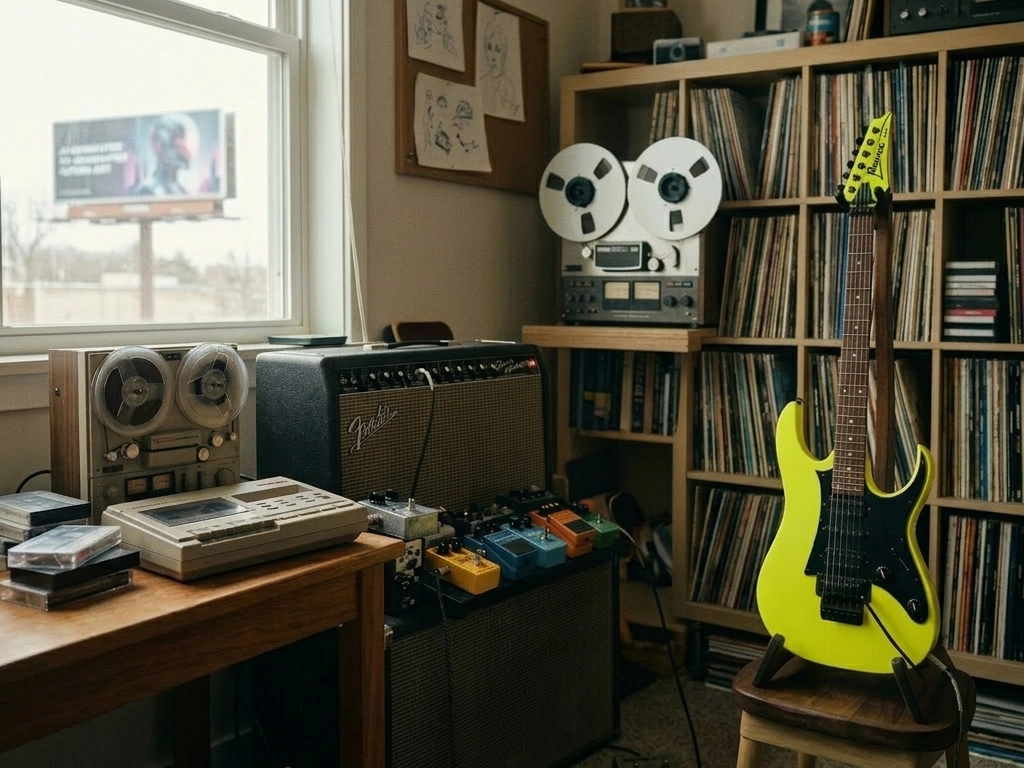
It's no secret that AI is getting good at making art. In fact, it's become a bit of an existential crisis for working artists who are being directly impacted by it: models like Nano Banana can edit photos instantly, Midjourney can generate hero images in seconds, and Suno can make a catchy jingle in a few minutes. There is real impact on the livelihoods of artists, and this isn't likely to change as AI continues to improve.
I think something that gets left out of the conversation, though, is what this means for the evolution of art itself. Changes in technology have historically been met with new forms of art or stylistic evolutions that leverage the new tech, or in some cases even push back against it.
Evolution
I remember this experience vividly. I was in Palazzo Pitti in Florence. The museum itself is organized chronologically, letting you see the evolution of art over time. In rooms prior to the 1800s, portraits were the most common form of art. Lifelike depictions of nobility and the wealthy. Highly detailed, sharp lines and true to life. Once you hit the 1800s, though, the lines start to blur and the subjects become more abstract. Interestingly, this shift lines up directly with the invention of the camera and the first photograph in 1826. Now, for the first time, it was cheap and easy to capture a true-to-life image. Consequently, the demand for portraits dropped, and artists had to find new ways to express themselves, to adapt and evolve.
I see a very similar pattern emerging with AI.
Devolution
Now here is where things get interesting. Prior to the digital technology revolutions in film, music and visual art, artistic processes all required analog methods. Film reels, tape recorders, paint and canvas. Older animations were done using hand-drawn frames and cels and stop motion. Computers and digital technology transformed these industries because the analog methods were difficult and time-consuming. Computers made it easier to edit, iterate and experiment. They made it easier to get closer to perfection. It was a clear step forward, and most artists embraced the new tools.
However, AI art by its very nature is digital. It has been trained on a history of art captured as digital data, and uses advanced algorithms to create a digital artifact that approximates a real-world process. But that's all it can do. It can't paint a canvas, record a tube amp, or capture a performance on film.
What I suspect is going to happen in the years to come is that analog methods are going to make a resurgence. As AI craters the value of digital art and perfection, truly human forms of expression are going to become relatively more scarce and valuable. The imperfections will become the point. The human touch, the live performance, the hand-drawn line, the tape hiss, and the grain of film. These are all things that AI can't replicate and that are going to become more desirable as the cost of producing AI content drops and the amount of content explodes.
People get bored quickly, and the truly unique and stimulating works are going to come from outside the training data. We are already seeing how fast trends come and go with AI art. The Studio Ghibli style was a flash in the pan that exploded in popularity for a few weeks and then disappeared. When art comes cheap and easy, it becomes uninteresting and disposable. The best things in life are worth waiting for.
For Me
Perhaps I'm a bit biased, but in my own artistic pursuits, I've been leaning into the analog. I recently overhauled my guitar signal chain to be entirely analog from guitar to the amp. For modulation and delay, I opted for pedals that use classic bucket-brigade technology. I even bought a Fender Deluxe Reverb specifically so I could have a tube amp with a real spring reverb. Basically all reverb pedals on the market are digital, convolution-style reverbs. The Indiana band Hoops released their first three demos recorded on tape, and I always loved the distinct sound compared to contemporary recordings. It instantly stands out as unique and different. For me, this is one of the ways I'd like to stand out in this new world of art.